Slate vs Tile Roofing: Which Lasts Longer in Irish Weather?
When it’s time for a new pitched roof, the material choice usually comes down to natural slate or tile — concrete or clay. Both perform well in Ireland’s wet, windy climate, but they diverge sharply on cost, weight, lifespan, and how they age. Here’s how they actually compare for Irish conditions.
Natural Slate: The Traditional Choice
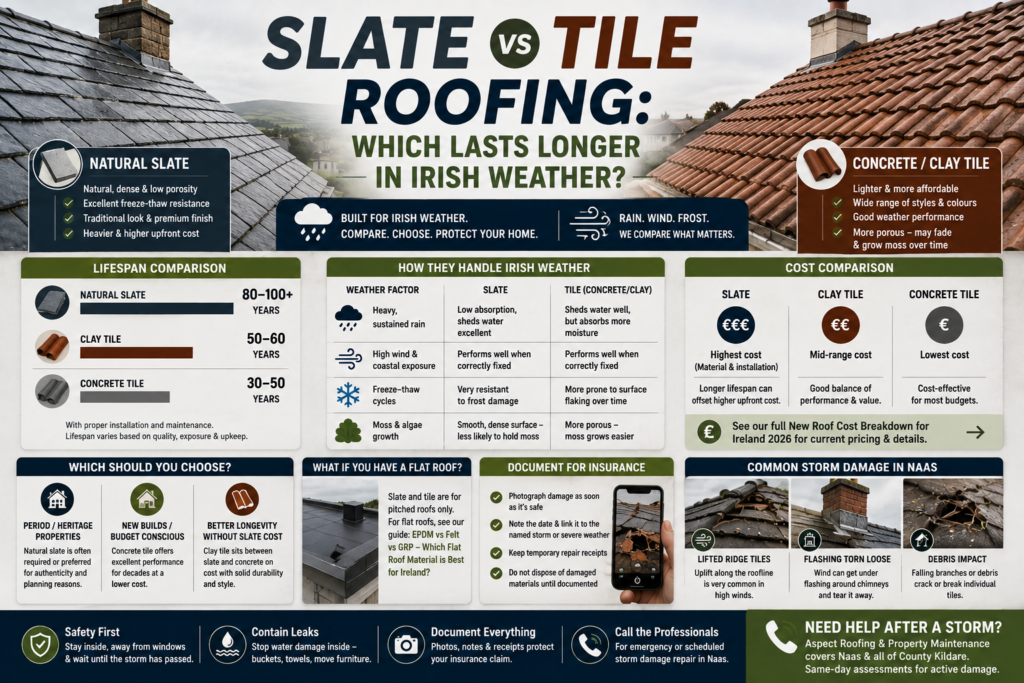
Natural slate has been the default for older Irish housing stock for a reason — it’s dense, low-porosity, and sheds water without absorbing much of it, which matters in a climate defined by persistent rain rather than occasional downpours. It also handles freeze-thaw cycles well, since it doesn’t hold enough moisture to crack when temperatures drop.
The trade-offs are weight and cost. Slate is heavy, which means the roof structure underneath needs to be built or confirmed to handle the load, and it’s the more expensive material both to buy and to install, since it requires more skilled, careful fitting than tile.
Concrete and Clay Tile: The Modern Standard
Concrete tile is the most common choice for newer builds and replacements across Ireland — lighter than slate, less expensive, and available in profiles that mimic the look of slate reasonably well. Clay tile sits between the two on cost and offers strong weather resistance with a more distinctive finish, though it’s less common than concrete locally.
Concrete tile’s main weakness against Irish weather is porosity — it absorbs more moisture than slate, which over decades can lead to surface degradation, moss growth being more likely to take hold, and a gradual colour fade that slate doesn’t experience to the same degree.
Lifespan Comparison
- Natural slate: 80–100+ years with proper installation and maintenance — many Irish slate roofs from the early 1900s are still original
- Clay tile: 50–60 years typically
- Concrete tile: 30–50 years, depending on quality and exposure
Slate’s dramatically longer lifespan is the main argument for its higher upfront cost — spread over the roof’s lifetime, it can work out competitive with tile despite costing more to install initially.
How Each Performs Against Specific Irish Weather Conditions
- Heavy, sustained rain: slate’s low absorption gives it a slight edge, though both materials shed water effectively when properly installed
- High wind and coastal exposure: both perform well when correctly fixed; wind damage more often comes down to installation quality and fixing method than the material itself
- Freeze-thaw cycles: slate’s density resists frost damage better; concrete tile is somewhat more prone to surface flaking over many freeze-thaw cycles, particularly with older or lower-quality tiles
- Moss and algae growth: concrete tile’s porous surface is more hospitable to moss than slate’s smooth, dense surface, meaning tiled roofs often need more frequent cleaning
Cost Comparison
Natural slate typically costs significantly more than concrete tile for both materials and installation, reflecting both the material cost and the more specialised fitting it requires. Clay tile sits in between. For homeowners weighing the decision, our new roof cost breakdown covers current pricing across all three materials in more detail, including what drives the cost within each option.
Which Should You Choose?
If you’re in a period property, especially one where slate is original or expected for planning/conservation reasons, slate is often the only appropriate choice regardless of cost. For a standard new build or full re-roof where budget is a real constraint, concrete tile delivers solid performance for several decades at a fraction of slate’s cost. Clay tile is worth considering if you want better longevity than concrete without slate’s price tag, and the aesthetic suits the property.
What If You Have a Flat Roof Instead?
This comparison applies specifically to pitched roofs. If you’re dealing with a flat or low-pitch roof, slate and tile aren’t relevant options — that’s a different material decision entirely. See our comparison of EPDM vs felt vs GRP for flat roofs if that’s what you’re working with.
Frequently Asked Questions
Is slate or tile better for Irish weather?
Both perform well. Slate has the edge on longevity and low water absorption; concrete tile is significantly cheaper and performs solidly for several decades.
How long does a slate roof last compared to tile?
Natural slate typically lasts 80–100+ years, clay tile 50–60 years, and concrete tile 30–50 years.
Is slate more expensive than tile in Ireland?
Yes, both in material cost and installation, though its much longer lifespan can offset that over the roof’s lifetime.
Does my roof structure need reinforcing for slate?
Slate is considerably heavier than tile, so an existing roof structure should be checked to confirm it can support the load before switching materials.
Which material needs less maintenance, slate or tile?
Slate generally needs less frequent cleaning since it resists moss and algae growth better than the more porous surface of concrete tile.
Planning a New Roof Installation?
Whether you’re leaning toward slate, clay, or concrete tile, our new roof installation service covers all three across County Kildare, with an honest recommendation based on your property, budget, and how long you need the roof to last. Get in touch to discuss which material makes sense for your new roof installation, or check our cost guide first if budget is the main question right now.